

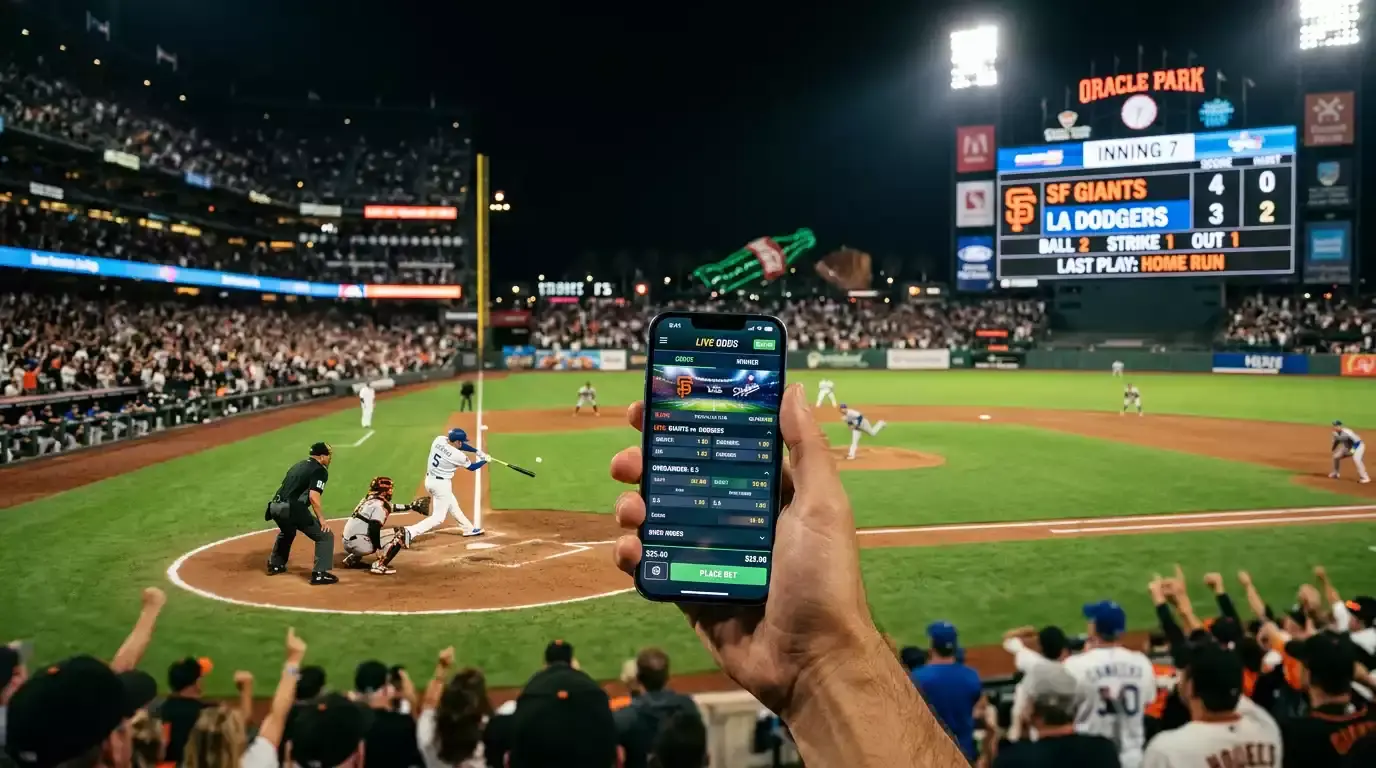
Pricing In-Play Market Volatility During MLB Series
Game 3 of the 2025 World Series was the moment that crystallised something I had suspected for years. The Dodgers trailed 4-1 heading into the sixth inning, and the live moneyline had drifted to roughly +280. Within forty-five minutes they had levelled the score, and by the eighth the line had swung past -150 in their favour. Anyone who had watched the first two games of the series — and understood the bullpen state of the Blue Jays after two hard-fought contests — saw the swing coming before the odds did.
Live betting on a standalone MLB game is reactive: you are reading what is happening on the field and guessing what comes next. Live betting within a series adds a second layer. You carry information from previous games — which relievers are spent, whether a lineup has looked comfortable against a particular pitch type, how the travel schedule has affected energy levels. That accumulated context is your edge, because the algorithms that set in-play odds update faster on what is happening right now than on what happened two nights ago.
The numbers confirm the opportunity. In-play wagering accounted for 62.35% of online betting revenue in 2025, growing at a compound annual rate of 13.62% and projected to keep climbing through 2031. That growth reflects both bettor appetite and operator investment in live markets — but the models powering those markets are strongest on sports with continuous action like football. Baseball’s stop-start rhythm, with discrete plate appearances and pitching changes, creates pauses where the live line sometimes lags behind informed bettors. During a series, those lags get wider because the relevant variables — bullpen availability, lineup familiarity, managerial tendencies — compound across games in ways the algorithm underweights.
During in-play wagering, conducting thorough MLB bullpen analysis for betting is crucial to predicting late-inning collapses.
Three Reliable Entry Points for Live MLB Bets
I have tracked my own in-play betting log across three full postseasons, and the clearest pattern is that not all moments in a baseball game offer equal value. Most of the time, live odds are efficient enough that you are simply paying the vig for the privilege of reacting. But three specific situations consistently create exploitable windows.
The first is the starter exit. When a starting pitcher is pulled — especially in the fifth or sixth inning of a closely contested game — the live line adjusts based on the incoming reliever’s season-long statistics. During a series, that adjustment often misses context. A closer who threw thirty pitches the previous night may have weaker stuff tonight, but his career ERA still reads 2.40, so the algorithm barely moves the price. If you have been tracking workload across the series, you know something the model undervalues. MLB runs a 162-game regular season producing 2,430 total games, which gives relievers deep statistical profiles — but those profiles obscure short-term fatigue effects that matter enormously in a compressed postseason schedule.
The second entry point is the middle innings of a game where the score has diverged from the series narrative. If a heavy series favourite falls behind 3-0 after two innings, the live moneyline overreacts to the current deficit because the model weighs the scoreboard heavily. But series context tells you this team’s lineup saw the same starter two days ago and adjusted — the early deficit may not hold. This is not a guarantee, but it is a systematic mispricing I have seen repeatedly.
The third is the late-inning total. By the seventh inning, you have a clear picture of both bullpens’ availability for the remainder of the game. If the total was set at 8.5 pregame and the score sits at 3-2 through six innings, the live total will be adjusted, but it may not fully account for the fact that both managers are about to deploy their weakest remaining arms because they are saving their best relievers for tomorrow’s elimination game. That forward-looking calculation is where series-aware bettors find value.
Momentum Is Real but Overpriced: Avoiding Recency Bias
Here is where I have lost the most money over the years, so I will be blunt about the trap. A team that wins Game 1 and Game 2 of a series “has momentum.” Pundits repeat it, bettors feel it, and the live odds during Game 3 reflect it. When that team scores first in Game 3, the in-play line moves sharply in their favour because the narrative reinforces the price.
The problem is that momentum in baseball is one of the most statistically fragile concepts in professional sport. Home teams win 54% of all MLB regular season games — a thinner advantage than in any other major American league. Extrapolating a two-game sample into a predictive force defies everything we know about baseball variance. I have learned to treat “momentum” as a signal of public sentiment rather than a signal of future outcomes. When the crowd bets momentum, the line moves, and that movement often creates value on the other side.
The specific version of this trap that costs series bettors money is the Game 3 overreaction. A team that loses the first two games at home now travels for Games 3, 4, and 5. Public perception says they are finished. The live line during Game 3 prices them as if they are finished. But the historical record shows that teams down 0-2 in seven-game series win the series roughly 15-20% of the time — a low probability, certainly, but not as low as the live odds often imply. I am not suggesting you bet every 0-2 deficit, but I am saying that the in-play price on the trailing team in Game 3 is frequently generous enough to warrant attention.
The discipline here is to separate what you have seen with your own eyes over the last two games from what the data says about the next five possible games. Your eyes carry recency bias. The data does not.
Stay updated with real-time odds and in-play tactics on our trusted MLB betting portal.
Latency and UK Platform Delays: Practical Limitations
I need to address something that affects every UK-based MLB live bettor and that no strategy guide can fully solve: platform latency. When you place a live bet on a UK bookmaker app, there is a delay between the moment you tap “place bet” and the moment the bet is accepted. During that window, the odds can move, and the bookmaker can reject your bet or offer revised terms. This is standard practice and not unique to MLB, but it matters more in baseball because the game state can change on a single pitch.
A strikeout, a home run, or a pitching change happens in seconds. If your feed is even slightly behind the actual action — and most UK streaming feeds run three to ten seconds behind real time — you are betting on information the bookmaker’s model has already absorbed. This is why I avoid live betting on individual pitches or at-bats from a UK platform. The latency disadvantage is too steep for micro-level wagers.
Where in-play betting from the UK does work is on the broader inflection points I described above: starter exits, middle-inning score divergences, and late-inning total reassessments. These are situations that develop over several minutes, giving you time to assess, decide, and place the bet before the line fully adjusts. They are also less susceptible to single-pitch outcomes, so a few seconds of feed delay does not undermine your edge.
One practical tip: if you are serious about live MLB betting from the UK, use a data feed alongside your video stream. Gameday pitch trackers and live box score apps update faster than video, and they give you the information you need to make moneyline and totals decisions without relying on visual confirmation of every play.
