

Evaluating Preseason Odds for World Series Longshots
On Opening Day 2015, the Kansas City Royals were priced at +3300 to win the World Series. In the language of UK fractional odds, that is 33/1 — the kind of price that sits at the bottom of a futures board and draws a sympathetic chuckle rather than serious money. Seven months later, the Royals were lifting the Commissioner’s Trophy, and anyone who had taken that opening-day price was holding a ticket worth thirty-three times their stake. The Texas Rangers pulled off a similar trick in 2023, opening at +3200 and winning the whole thing.
These are not fairy tales. They are data points, and they carry specific lessons for bettors who are willing to look past the preseason favourite and ask a different question: not “who is most likely to win?” but “whose price is most detached from their realistic ceiling?”
Royals 2015, Rangers 2023 and Other Longshot Champions
The Royals’ 2015 run was built on a specific formula: elite bullpen depth, high-contact offence, and a postseason environment that amplified both strengths. During the regular season, their 95-67 record was good but not historic. The preseason odds reflected a perception that they had overachieved in 2014 (when they lost the World Series in seven games to the Giants) and were due for regression. The market was wrong, and the reason it was wrong is instructive: the traits that made the Royals dangerous — late-inning relief dominance and aggressive baserunning — were undervalued by models that weighted starting pitching and run differential more heavily.
The Rangers’ 2023 championship was a different kind of longshot. They were coming off a disappointing 2022, had made significant but under-the-radar acquisitions, and entered the season without the national spotlight that followed the Dodgers, Braves, and Astros. Their +3200 opening price reflected genuine scepticism about whether their pitching staff could hold up over a full season. It could, barely — they won 90 games and entered the postseason as a Wild Card team. But once there, their combination of power hitting and postseason-tested pitching carried them through four rounds.
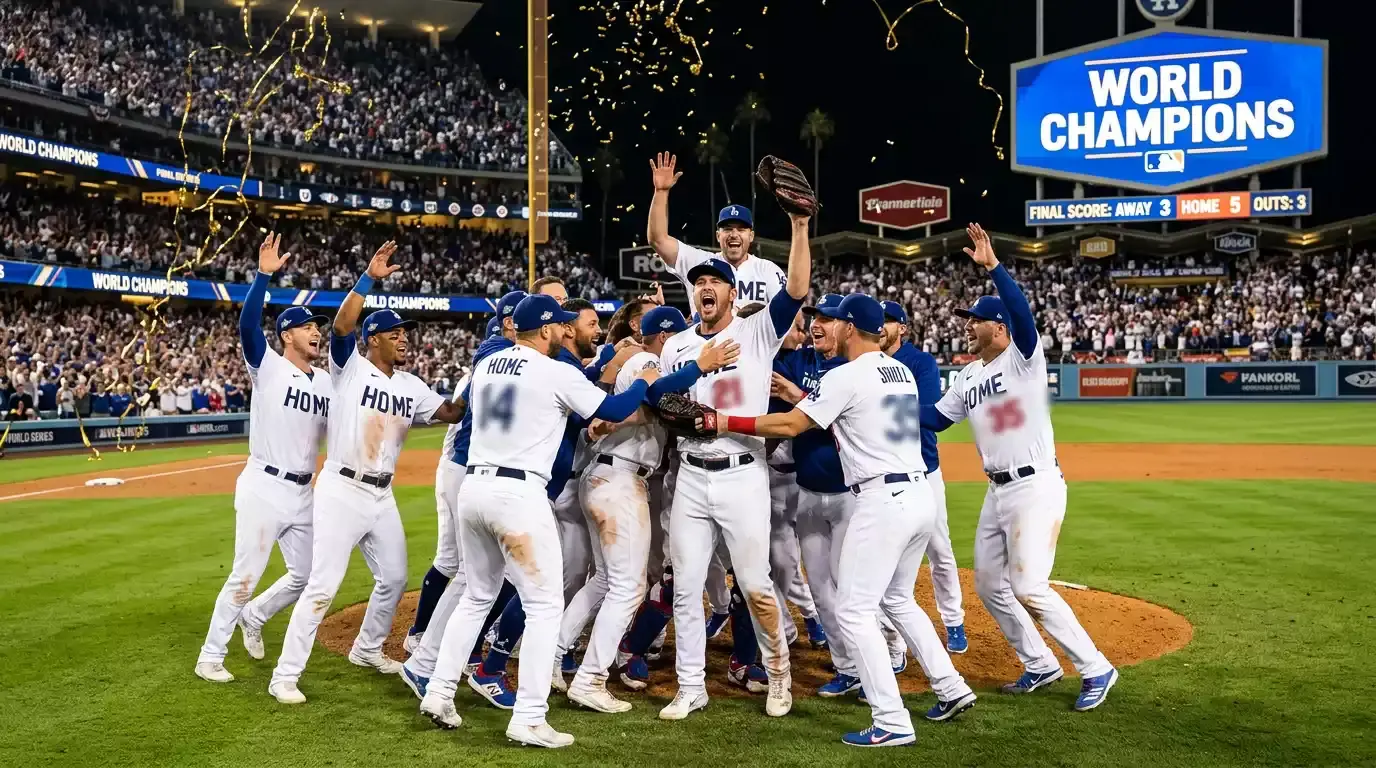
The 2025 World Series between the Dodgers and Blue Jays offered a contrast. The Dodgers entered as heavy favourites at -210, and they won — but it took seven games, and the result was never comfortable. Before the series, the Dodgers had drawn 11.6% of all futures tickets and 19.8% of total handle at BetMGM, making them the public’s overwhelming choice. That concentration of money on the favourite created inflated prices on the other side throughout the season, though the Blue Jays were not a traditional longshot — they were a genuine contender whose price simply benefited from the public’s fixation on Los Angeles.
Common Traits Among World Series Longshots
After studying every World Series winner from 2010 onward, I have identified three traits that appear consistently in teams that outperform their preseason odds.
The first is bullpen depth. Every longshot champion in the past fifteen years had a top-ten bullpen by some measure — whether it was ERA, leverage performance, or late-inning save rate. The postseason compresses rest days and increases the number of high-stakes innings played with the bullpen, which means a team with eight reliable relievers has a structural advantage over a team with four good ones and four question marks. The regular season can mask bullpen weakness because of off-days and lower stakes. October exposes it ruthlessly.
The second is lineup balance. Longshot champions tend not to rely on one or two superstar hitters. Instead, they have deep lineups where the seven and eight hitters can damage a pitcher nearly as much as the three and four hitters. This matters in a series because the opposing team can strategically pitch around the stars but cannot pitch around an entire lineup. The Royals’ 2015 offence was the prototype: no individual player carried the team, but the collective approach — high contact, aggressive in the running game — wore down opponents across a seven-game series.
The third trait is an undervalued starting pitcher who peaks at the right time. The Rangers had Max Scherzer and Nathan Eovaldi delivering playoff performances that exceeded their regular-season numbers. The Royals had Edinson Volquez pitching the game of his life in the clincher. These are not predictable events, but they are not entirely random either — pitchers with postseason experience and a specific skill set (high ground-ball rate, ability to limit damage with runners on base) tend to elevate their performance in October. If a team’s rotation includes one or two pitchers with that profile, the longshot price may be undervaluing their postseason ceiling.
How to Identify Potential Longshot Value Before the Season Starts
I am not going to pretend that picking a World Series longshot is easy or consistent. Most longshots lose. That is why they are longshots. But the exercise of scanning the futures board for undervalued teams sharpens your understanding of the sport and occasionally produces a bet that transforms a season’s returns.
My screening process starts in February, during spring training. I look for teams priced between +1500 and +3500 that meet three criteria: a bullpen ranked in the top third of the league by projected WAR, a lineup with at least six above-average offensive players (not just two or three stars), and a rotation that includes at least one pitcher with meaningful postseason experience. Teams that tick all three boxes go on my watchlist. I do not bet them immediately — I wait until the first two weeks of the season to see whether the roster is performing as projected, and then I take the price if it has held steady or drifted out.
The key insight is that longshot futures are not about picking the winner. They are about identifying teams whose ceiling is higher than their price implies. At 25/1, a team needs to win the World Series 4% of the time to be a breakeven bet. If your assessment puts their true probability at 6-8%, you have significant positive expected value — even knowing that the bet will lose 92-94% of the time. The discipline is treating futures as a portfolio: two or three longshot positions per season, sized appropriately, with the understanding that most will lose and the occasional winner will more than compensate.
Timing matters too. The optimal windows for futures betting are opening day and the post-trade-deadline period. Opening-day prices carry the most uncertainty and the widest value. Post-deadline prices reflect roster improvements that have not been fully priced in. Both moments offer opportunities to catch a future longshot champion at a price that will look absurd in retrospect — and to accept that it will more often look like a losing ticket that teaches you nothing except patience.
