

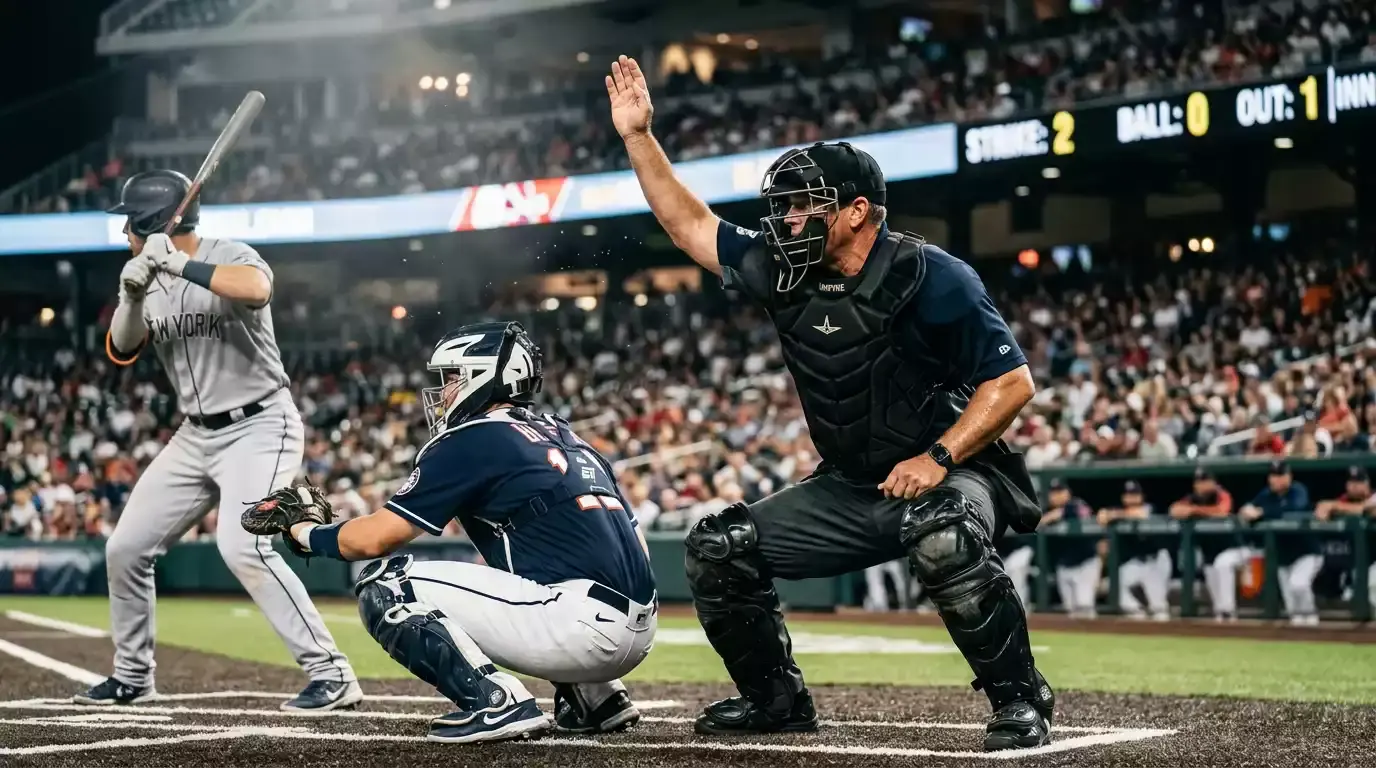
Measuring Strike Zone Variations from Home Plate Umpires
In September 2024, I had the under on a Braves-Phillies game at 8.5. Both starters were dealing, the wind was calm, and the park factor was neutral. The game finished 7-6, with eight walks between the two teams. The home plate umpire that night had the widest strike zone in baseball — or at least that is what I assumed. When I checked his scorecard the next day, I realised the opposite: he had a tight zone, which meant pitchers could not get borderline calls, pitch counts climbed, starters exited early, and the bullpen mess that followed produced a crooked number in every late inning. The umpire’s zone did not just affect totals — it rewired the entire game flow.
MLB’s 2,430 regular season games are officiated by a rotating pool of roughly 90 umpires, and each one calls the strike zone slightly differently. The variation is not a secret — data sites publish umpire scorecards after every game, tracking called-strike accuracy, zone size, and consistency. What remains underutilised is the application of that data to betting markets. The bookmaker sets the line based on the pitchers, lineups, and park factor. The umpire is a known variable that most models underweight and most bettors ignore entirely.
Umpire Scorecards and Called Strike Rates: Where to Find the Data
Umpire tendency data has become remarkably accessible over the past few years. Several free sites publish detailed scorecards within hours of each game, tracking metrics like overall accuracy, consistency, expanded zone calls (pitches outside the zone called strikes), and squeezed zone calls (pitches inside the zone called balls). Across postseason history, home teams win roughly 54.2% of games, but that percentage can shift by a few points depending on whether the umpire’s zone favours the home team’s pitching staff.
The most useful metric for bettors is the umpire’s historical called strike rate — the percentage of pitches they call strikes out of all taken pitches. The league average sits around 32-33%. An umpire with a called strike rate of 36% has an expanded zone that benefits pitchers: more borderline calls go their way, which means lower walk rates, shorter at-bats, and fewer baserunners. An umpire at 29% has a tight zone that favours hitters: more borderline pitches are called balls, pitch counts climb, and batters see more hittable pitches because the pitcher cannot waste borderline offerings.
I compile a spreadsheet of each umpire’s called strike rate, average total runs in their games, and K-rate differential (how their games’ strikeout rates compare to the league average). This takes about thirty minutes at the start of the season and five minutes per day to update. The data accumulates quickly — by midseason, every umpire has enough games to establish a reliable pattern. Before placing any totals or strikeout prop bet, I check which umpire is behind the plate and adjust my assessment accordingly.
How a Wide or Tight Zone Moves Totals and K Props
The impact of umpire zone size on totals is more significant than most bettors realise. My tracking data shows that games called by the five widest-zone umpires in the league average roughly 0.7 fewer total runs than games called by the five tightest-zone umpires. That is not a rounding error — 0.7 runs on a totals line is the difference between a comfortable over and a push, or between a losing under and a winner.
The mechanism works through pitch sequencing and at-bat length. A wide-zone umpire lets pitchers attack the margins, which produces more called strikes, faster outs, and shorter innings. Starters pitch deeper into games because their pitch counts stay low, which reduces bullpen exposure and keeps the fresher (and usually better) arms on the mound. A tight-zone umpire forces pitchers to throw more pitches in the heart of the zone, which produces harder contact, more walks, and earlier starter exits. The cascading effect on bullpen usage means late-inning scoring increases because the weaker relievers enter the game sooner.
For strikeout props, the umpire effect is even more direct. A wide-zone umpire generates more called strikeouts — the batter takes a borderline pitch expecting it to be called a ball, and it is not. A tight-zone umpire suppresses called strikeouts, which means the pitcher needs to generate swinging strikes to record Ks. A power pitcher who relies on whiffs is less affected by umpire zone; a finesse pitcher who paints the corners is heavily affected. Matching the pitcher type to the umpire tendency gives you a second filter for K prop strategy beyond the raw matchup data.
Umpire Crew Rotation in a Postseason Series
During the regular season, umpire assignments are published the morning of each game, giving bettors several hours to incorporate the information before first pitch. Postseason assignments work differently: a four-man crew is assigned to each series, and the crew members rotate positions across games. The home plate assignment rotates in a fixed order, which means once you know the crew, you know which umpire will be behind the plate for each game of the series.
This is a significant informational advantage for series bettors. Before Game 1 of a postseason series, you can map out the home plate umpire for all potential games and identify which ones favour the over, the under, or specific strikeout prop sides. If Umpire A (wide zone) is behind the plate for Games 1 and 5, and Umpire B (tight zone) handles Games 2 and 6, you can plan your totals and prop bets across the series rather than reacting game by game.
I use this information in two ways. First, as a tiebreaker: if I am torn between the over and the under on a particular game, the umpire assignment breaks the tie. Second, as a stacking tool: if a wide-zone umpire is behind the plate for two games in a series, I may take the under on both games as a connected position, knowing that the umpire tendency creates a persistent bias across both contests. The correlation between those two bets is not perfect — other factors intervene — but it is real enough to justify treating them as linked positions within my series staking plan.
One caveat: the umpire effect is a modifier, not a predictor. A wide-zone umpire does not guarantee a low-scoring game, and a tight-zone umpire does not guarantee a slugfest. What they do is shift the probability by a few percentage points in a specific direction. Over a full season or a full postseason, those few percentage points compound into meaningful edge — but on any single game, the umpire is one variable among many. Treat it as the final check in your process, not the first.
