

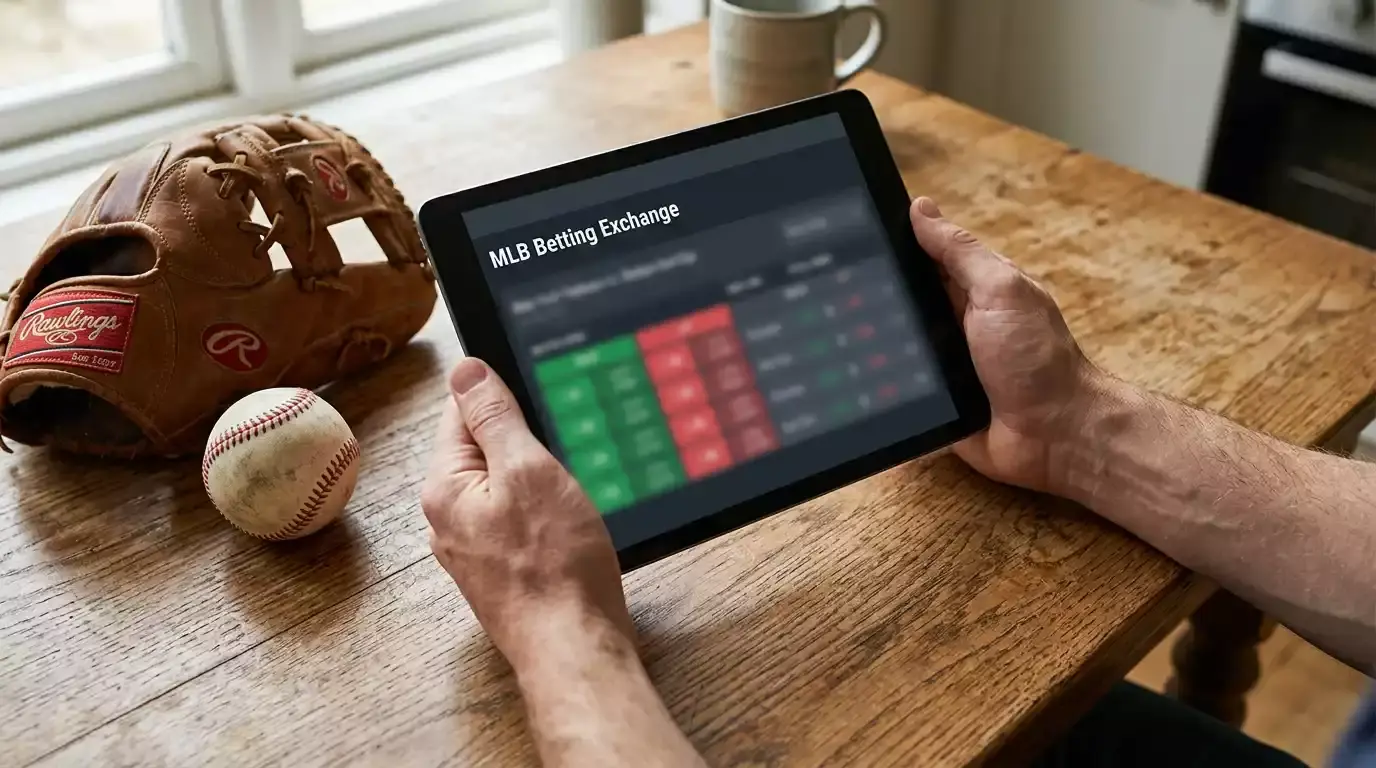
Laying MLB Odds on UK Betting Exchanges
My introduction to exchange betting came during a 2022 World Series game. I was convinced the Phillies would not cover the run line but could not find decent value on the moneyline with traditional bookmakers. A friend told me to lay the Phillies on the exchange instead — effectively betting they would not win at odds I set myself. The trade filled in seconds, the Phillies lost, and I pocketed a cleaner profit than any fixed-odds market would have offered. That single trade reshaped how I approach every MLB bet.
Betting exchanges operate on a fundamentally different model from traditional bookmakers. Instead of a company setting odds and taking the other side of your bet, you trade directly with other punters. One person backs an outcome; another lays it. The exchange takes a small commission on winning bets — typically 2% to 5% — and the result is tighter margins, better prices, and the ability to trade positions in and out during a game. For a sport with the volume of MLB — 2,430 regular season games, each generating hundreds of in-play markets — exchanges offer flexibility that fixed-odds platforms simply cannot match.
How Exchange Odds Compare to Traditional Bookmaker Pricing
I ran a side-by-side comparison across 50 MLB games last season, tracking the moneyline price on three traditional platforms against the best available price on an exchange. The exchange offered a better back price in 38 of those 50 games. The average improvement was 3.2%, which does not sound dramatic until you compound it over hundreds of bets across a season. On a GBP 1,000 monthly turnover, that is roughly GBP 30 saved in margin every month — money that goes straight to your bottom line rather than the operator’s.
The reason is structural. Traditional bookmakers build their margin into both sides of the line. The UK gambling market generated GBP 11.5 billion in gross gambling yield last year, and the bulk of that comes from the gap between true probability and the odds offered. Exchanges eliminate that gap. The only cost is the commission on your net winnings, and the effective overround on exchange markets typically runs between 101% and 102%, compared with 104% to 108% on traditional MLB moneylines.
There is a catch, and I have been burned by it. Exchange liquidity on MLB is thinner than on Premier League football or horse racing. A Championship match might have hundreds of thousands of pounds matched on the exchange before kick-off. A Tuesday afternoon game between the Royals and the Guardians might have a few thousand. Thin liquidity means your bet might not fill at your requested price, or might only partially fill. For big-market games — Yankees, Dodgers, Red Sox — liquidity is solid. For small-market midweek fixtures, you need patience or a willingness to accept the price the market offers.
Laying as a Betting Tool — When to Bet Against
What does it actually mean to lay a team? I think of it as selling an outcome. If the Yankees are 1.80 on the exchange and I lay them, I am offering to pay out at 1.80 if they win, in exchange for keeping the backer’s stake if they lose. My liability is the potential payout minus the stake — so if someone backs the Yankees for GBP 10 at 1.80, my liability is GBP 8 (the potential profit they would collect). If the Yankees lose, I keep their GBP 10 minus commission.
Laying is not contrarianism for its own sake. It is a precision tool. I lay teams when I believe the market overestimates their win probability but the underdog price on the back side does not offer enough value to justify a positive bet. The 2024 Dodgers were a perfect example during their mid-season slump — their name recognition kept the back price short even when their rotation was depleted, and laying them during that stretch was consistently profitable.
The psychological shift matters too. Traditional betting forces binary thinking: back or abstain. Exchanges add a third option. I can back the underdog, lay the favourite, or do both across different price points to create a guaranteed profit if the market moves. That versatility changes how you evaluate every game on the slate.
Trading In-Play on MLB Exchanges
In-play wagering accounts for 62.35% of online betting revenue in the UK, and exchanges thrive in this space. The concept is straightforward: back a team before the game at one price, then lay them in-play at a shorter price after events move in your favour, locking in a profit regardless of the final result. I call it “greening up” — the term comes from the matched betting community, but it applies perfectly to exchange trading.
Last June I backed the Padres at 2.40 before a game, watched them take a 3-0 lead through four innings, then laid them at 1.35 in-play. The maths guaranteed a profit whether they won or lost from that point. If they won, my back bet paid more than my lay liability. If they collapsed (which baseball teams do with remarkable regularity), my lay profit exceeded my back stake. The trade closed in the sixth inning and I went to bed with the result irrelevant.
MLB is particularly suited to in-play exchange trading because the game unfolds in discrete events — at-bats, innings, pitching changes — each of which shifts probability in measurable increments. A solo home run in the third inning moves the exchange price less than a three-run homer in the seventh. Understanding these leverage points lets you time your trades for maximum impact. The principles of live betting strategy transfer directly to exchange trading, with the added advantage that you control your exit point.
Commission, Tax, and the True Cost of Exchange Betting
Exchange commission varies by platform and by your volume tier, but the standard rate sits between 2% and 5% on net market profits. Some platforms offer reduced rates for high-volume traders — drop below 2% if your annual turnover crosses certain thresholds. That commission replaces the traditional bookmaker’s margin, and for most MLB bettors the exchange commission works out cheaper.
The tax picture for UK punters is clean. Betting duty shifted from the punter to the operator in 2001, meaning you pay no tax on exchange winnings. The operator pays Remote Gaming Duty — which rose from 21% to 40% in April 2026 — but that cost falls on the exchange, not you. Your net profit is your net profit, no HMRC complication.
One cost that catches newcomers off guard is the premium charge some exchanges levy on long-term profitable accounts. If your lifetime net profit exceeds certain thresholds and your ratio of charges paid to profit earned drops below a set percentage, the exchange applies a supplementary charge on top of the standard commission. It only affects consistently profitable bettors, but if you are good enough to face it, you need to factor it into your edge calculations.
Where Exchange Betting Fits in an MLB Strategy
I do not use exchanges for everything. Quick player prop bets, NRFI markets, and small-stake accumulators are faster and simpler on traditional platforms. Exchanges shine on moneylines, totals, and series markets where the price difference justifies the extra step of placing and managing a trade. They also shine on any bet where I want the option to exit early — which in a 162-game season with constant information flow is most bets worth more than a few quid.
The best approach combines both. I check the exchange price first, then compare it against three or four traditional bookmakers. If the exchange offers a better back price net of commission, I take it. If a bookmaker’s promotional pricing (enhanced odds, money-back specials) beats the exchange, I take that instead. The goal is not loyalty to a platform. The goal is extracting the best available price on every bet, every day, across every game on the slate. Over a full MLB season, that discipline compounds into a measurable edge that no single platform can replicate on its own.
