

Translating US Terminology for UK MLB Punters
When I started betting on baseball from the UK, I felt like I was reading a foreign language. American sports betting terminology does not map neatly onto the vocabulary I grew up with on football and racing. “Chalk” does not mean what the darts crowd thinks it does. “Juice” is not a drink. And “dime line” has nothing to do with currency I have in my wallet. The UK gambling industry, which generated £11.5 billion in gross gambling yield in the year to March 2024, operates with its own set of terms — and translating between the American baseball lexicon and the British betting one is a prerequisite for making sense of the analysis, podcasts, and tipsheets that dominate the MLB betting space.
This glossary is organised alphabetically. I have included not just the definition of each term but a sentence of context explaining how and when you will encounter it in practice. MLB spans 2,430 regular season games, and the terminology below covers every market, metric, and concept you will need across the full season and into the postseason.
A-F: From Action to Futures
Action — a bet is “action” if it stands regardless of pitching changes. Some sportsbooks void bets when the listed starting pitcher is replaced before the game; an “action” bet bypasses that rule. If you bet “action” on the Yankees and their ace gets scratched, your bet still stands at the same price.
Accumulator (Parlay) — a multi-leg bet where all selections must win. UK bettors know this as an accumulator or acca; Americans call it a parlay. Same product, different name. The house edge compounds with each added leg.
Chalk — the favourite. “Betting the chalk” means backing the team the market expects to win. In a game where the Dodgers are -170 and the Padres are +150, the Dodgers are the chalk.
Closing Line Value (CLV) — the difference between the price you locked in and the final price before the game starts. Positive CLV means you got a better price than the market’s final assessment, which is the strongest predictor of long-term betting success.
Cover — to beat the spread. In MLB, covering the run line means the favourite won by 2+ runs (or the underdog lost by 1 or won outright). Borrowed from American football terminology but used identically in baseball.
Dime Line — a moneyline market with only a 10-cent gap between the favourite and underdog price. For example, -115/+105 is a dime line. Tighter than most UK bookmakers offer on MLB, but worth understanding when comparing American pricing.
F5 (First Five Innings) — a bet that settles after the first five innings are complete, isolating the starting pitching matchup and removing bullpen variance. Increasingly popular among analytical bettors.
Futures — a bet on an outcome that will be resolved in the future, typically the World Series winner or a team’s season win total. Futures lock your price at the time of placement, regardless of how odds move subsequently.
G-M: From Grand Salami to Moneyline
Grand Salami — the total runs scored across all MLB games on a given day, offered as a single over/under market. A niche bet but popular among bettors who want action on the entire daily slate without picking individual games.
GGY (Gross Gambling Yield) — the industry metric for operator revenue, calculated as total stakes minus payouts. The UK Gambling Commission uses GGY to measure market size, while American reports typically reference “revenue” or “hold.” Same concept, different labels.
Handle — the total amount wagered on a market or event. Not to be confused with hold (the bookmaker’s profit after payouts). A game with £500,000 in handle and 5% hold generates £25,000 in operator profit. Handle tells you how much money is in play; hold tells you how much the bookmaker kept.
Hook — a half-point on a total or spread. An 8.5 total includes a hook that prevents a push (draw). In MLB, the run line is always 1.5, which means there is always a hook — no pushes on the standard spread.
Juice (Vig) — the commission built into the odds. On a -110/-110 line, the juice is approximately 4.5%. UK bettors may be more familiar with “overround” as the equivalent concept. Both describe the margin the bookmaker extracts from the market.
Moneyline (Match Winner) — a straight bet on which team wins the game. No spread, no total — just the winner. UK platforms may label this “match winner” or “1X2” (though baseball has no draw, so it is always a two-way market).
N-S: From NRFI to Steam Move
NRFI / YRFI — No Run First Inning / Yes Run First Inning. A bet on whether either team scores in the top or bottom of the first inning. One of the fastest-settling markets in baseball, resolved within the first fifteen minutes of play.
Overround — the sum of implied probabilities across all outcomes in a market, minus 100%. A 104% overround means the bookmaker is charging 4% margin. Lower overrounds represent better value for the bettor. The UK term for what Americans call “vig” or “juice” applied to the whole market.
Public Money — the aggregate action from recreational bettors, typically characterised by a high volume of small bets. When “the public” is heavily on one side, the line may offer value on the other side if sharp money disagrees.
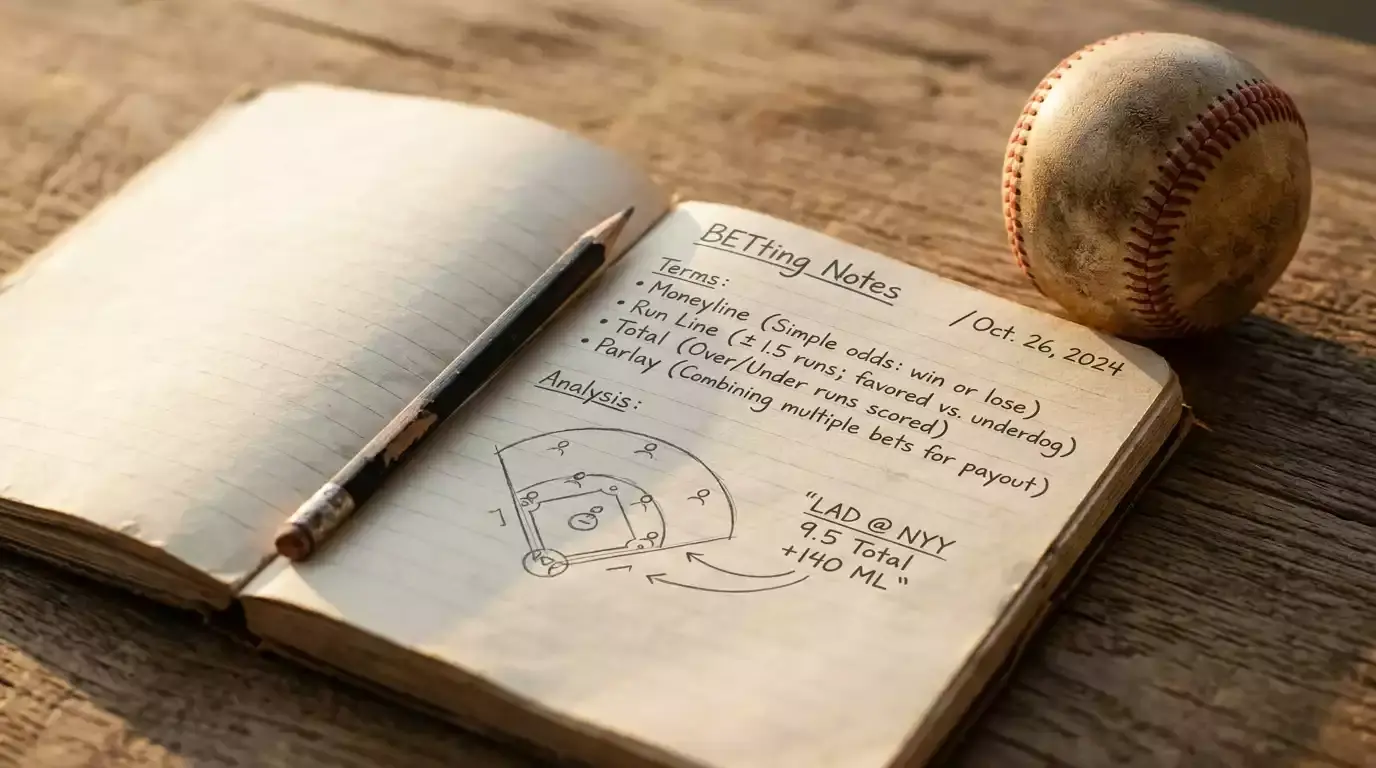
Run Line — MLB’s equivalent of the spread, fixed at 1.5 runs. The favourite is -1.5 (must win by 2+ runs); the underdog is +1.5 (must win outright or lose by 1). Unlike football or basketball spreads, the MLB run line does not change — only the price around it does.
Series Price — a bet on which team wins a multi-game series (typically best-of-three, five, or seven). Distinct from the game moneyline; the series price reflects the aggregate probability across all potential games in the series.
Sharp Money — large, informed bets from professional or syndicate-level bettors. Sharp money tends to move lines more effectively than public money because bookmakers respect the accounts placing these bets. Tracking sharp money through handle-versus-ticket divergence is a key analytical tool.
Steam Move — a sudden, significant line movement caused by sharp money arriving simultaneously at multiple sportsbooks. A steam move on the Yankees might see their moneyline shift from -140 to -155 within minutes across the entire market. These moves signal strong conviction from informed bettors.
T-Z: From Totals to Zone Rating
Totals (Over/Under) — a bet on the combined number of runs scored by both teams. The bookmaker sets a number (e.g., 8.5), and you bet on whether the actual total will be over or under that figure. UK bettors may see this labelled as “total match runs” on their platform.
Unit — a standardised bet size used to track performance. If your unit is £20, a “2-unit bet” is £40. Units allow bettors to compare results regardless of bankroll size. Most disciplined bettors set one unit at 1-2% of their total bankroll.
Vig — short for vigorish, the bookmaker’s commission on a bet. Interchangeable with “juice.” A -110 price carries approximately 4.5% vig. The lower the vig, the less you pay for the privilege of betting.
WAR (Wins Above Replacement) — a sabermetric catch-all stat estimating a player’s total contribution measured in wins. A 5-WAR player adds roughly five wins to his team over a full season compared to a replacement-level player. Used in betting to assess roster strength for futures and series prices.
wOBA (Weighted On-Base Average) — an advanced hitting metric that weights each offensive outcome by its run value. Unlike batting average, wOBA accounts for the fact that a home run is worth more than a single. A league-average wOBA is typically around .310-.320.
Knowing the language is not optional for UK bettors who want to engage seriously with MLB analysis. The best content — the podcasts, the data breakdowns, the strategic discussions — is written in American terminology. This glossary is your bridge between the UK and American betting worlds, and I recommend bookmarking it for reference throughout the season.
